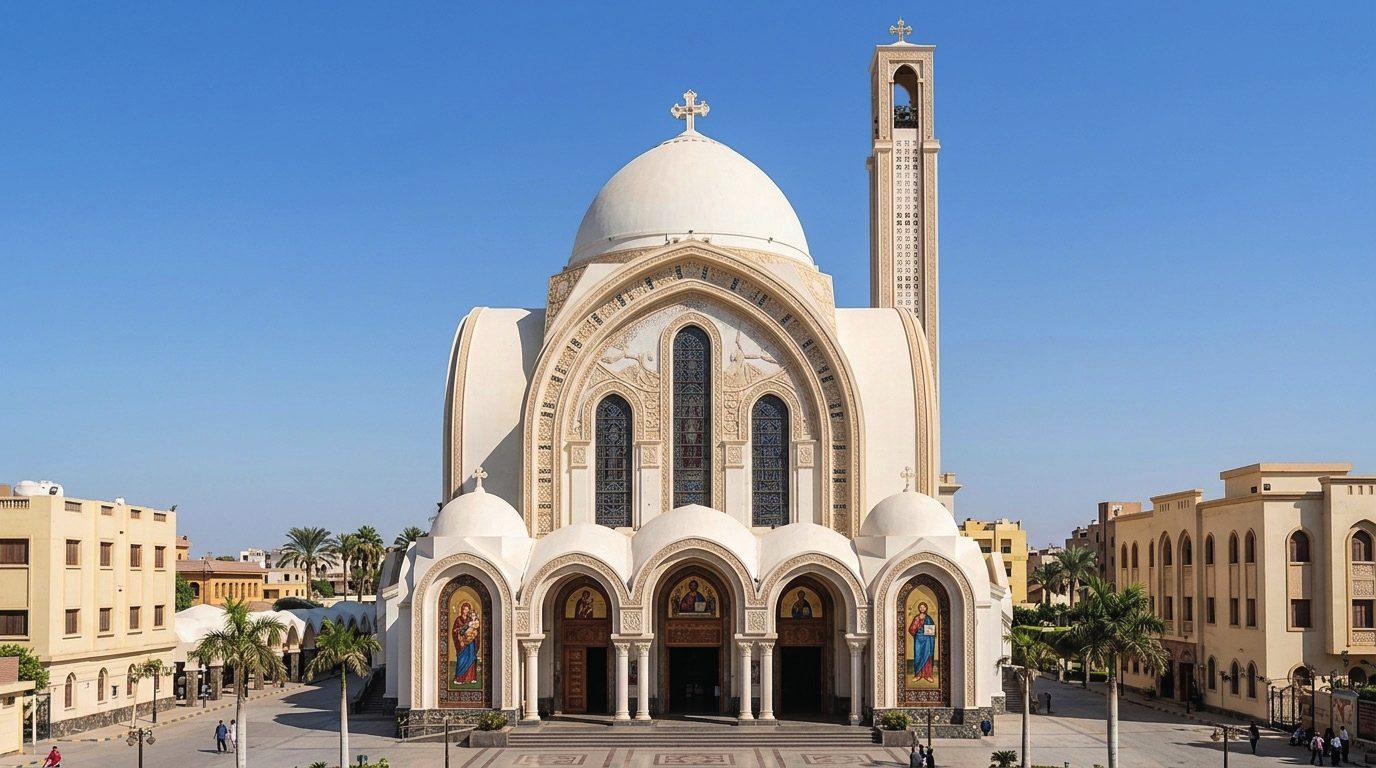
The word Copt is derived from the Greek word Aigyptos, which was, in turn, derived from "Hikaptah", one of the names for Memphis, the first capital of Ancient Egypt. The modern use of the term "Coptic" describes Egyptian Christians, as well as the last stage of the ancient Egyptian language script. Also, it describes the distinctive art and architecture that developed as an early expression of the new faith.
The Coptic Church is based on the teachings of Saint Mark who brought Christianity to Egypt during the reign of the Roman emperor Nero in the first century, a dozen of years after the Lord's ascension. He was one of the four evangelists and the one who wrote the oldest canonical gospel. Christianity spread throughout Egypt within half a century of Saint Mark's arrival in Alexandria as is clear from the New Testament writings found in Bahnasa, in Middle Egypt, which date around the year 200 A.D., and a fragment of the Gospel of Saint John, written using the Coptic language, which was found in Upper Egypt and can be dated to the first half of the second century. The Coptic Church, which is now more than nineteen centuries old, was the subject of many prophecies in the Old Testament. Isaiah the prophet, in Chapter 19, Verse 19 says "In that day there will be an altar to the LORD in the midst of the land of Egypt, and a pillar to the LORD at its border."
Although fully integrated into the body of the modern Egyptian nation, the Copts have survived as a strong religious entity who pride themselves on their contribution to the Christian world. The Coptic church regards itself as a strong defendant of Christian faith. The Nicene Creed, which is recited in all churches throughout the world, has been authored by one of its favorite sons, Saint Athanasius, the Pope of Alexandria for 46 years, from 327 A.D. to 373 A.D. This status is well deserved, after all, Egypt was the refuge that the Holy Family sought in its flight from Judea: "When he arose, he took the young Child and His mother by night and departed for Egypt, and was there until the death of Herod, that it might be fulfilled which was spoken by the Lord through the prophet, saying, "Out of Egypt I called My Son" [Mathew 2:12-23].
Perhaps the greatest glory of the Coptic Church is its Cross. Copts take pride in the persecution they have sustained as early as May 8, 68 A.D., when their Patron Saint Mark was slain on Easter Monday after being dragged from his feet by Roman soldiers all over Alexandria's streets and alleys. The Copts have been persecuted by almost every ruler of Egypt. Their Clergymen have been tortured and exiled even by their Christian brothers after the schism of Chalcedon in 451 A.D. and until the Arab's conquest of Egypt in 641 A.D. To emphasize their pride in their cross, Copts adopted a calendar, called the Calendar of the Martyrs, which begins its era on August 29, 284 A.D., in commemoration of those who died for their faith during the rule of Diocletian the Roman Emperor. This calendar is still in use all over Egypt by farmers to keep track of the various agricultural seasons and in the Coptic Church Lectionary.
For the four centuries that followed the Arab's conquest of Egypt, the Coptic Church generally flourished and Egypt remained basically Christian. This is due to a large extent to the fortunate position that the Copts enjoyed, for the Prophet of Islam, who had an Egyptian wife (the only one of his wives to bear a child), preached especial kindness towards Copts: "When you conquer Egypt, be kind to the Copts for they are your protégés and kith and kin". Copts, thus, were allowed to freely practice their religion and were to a large degree autonomous, provided they continued to pay a special tax, called "Gezya", that qualifies them as "Ahl Zemma" protégés (protected). Individuals who cannot afford to pay this tax were faced with the choice of either converting to Islam or losing their civil right to be "protected", which in some instances meant being killed. Copts, despite additional sumptuary laws that were imposed on them in 750-868 A.D. and 905-935 A.D. under the Abbasid Dynasties, prospered and their Church enjoyed one of its most peaceful era. Surviving literature from monastic centers, dating back from the 8th to the 11th century, shows no drastic break in the activities of Coptic craftsmen, such as weavers, leather-binders, painters, and wood-workers. Throughout that period, the Coptic language remained the language of the land, and it was not until the second half of the 11th century that the first bi-lingual Coptic-Arabic liturgical manuscripts started to appear. One of the first complete Arabic texts is the 13th century text by Awlaad El-Assal (children of the Honey Maker), in which the laws, cultural norms and traditions of the Copts at this pivotal time, 500 years after the Islamic conquest of Egypt were detailed. The adoption of the Arabic language as the language used in Egyptians' every-day's life was so slow that even in the 15th century al-Makrizi implied that the Coptic Language was still largely in use. Up to this day, the Coptic Language continues to be the liturgical language of the Church.
The position of the Copts began to improve early in the 19th century under the stability and tolerance of Muhammad Ali's dynasty. The Coptic community ceased to be regarded by the state as an administrative unit and, by 1855 A.D., the main mark of Copts' inferiority, the "Gezya" tax was lifted, and shortly thereafter Copts started to serve in the Egyptian army. The 1919 A.D. revolution in Egypt, the first grassroots display of Egyptian identity in centuries, stands as a witness to the homogeneity of Egypt's modern society with both its Muslim and Coptic sects. Today, this homogeneity is what keeps the Egyptian society united against the religious intolerance of extremist groups, who occasionally subject the Copts to persecution and terror. Modern day martyrs, like Father Marcos Khalil, serve as reminders of the miracle of Coptic survival.